
Overview
A maintenance team goes looking for a spare CPU for a line that has run without incident for over a decade, only to find the model it needs was withdrawn from manufacture some time ago. What is left in the supply chain is whatever distributors and brokers still hold, at whatever price that scarcity now commands. The team is left choosing between a like-for-like swap using increasingly hard-to-verify stock, or a migration to the current SIMATIC generation that nobody had budgeted for this year. That decision is playing out across UK manufacturing right now, on a scale most people outside the plant rarely see.
Siemens SIMATIC PLCs sit behind an enormous share of UK machine and process control, and the range has moved on considerably from the S7-300 and S7-400 generation many sites were originally commissioned with. The current S7-1200 and S7-1500 families, built around TIA Portal, cover everything from a single packaging machine to a plant-wide control architecture, and the two are not interchangeable choices; they are built for genuinely different jobs.
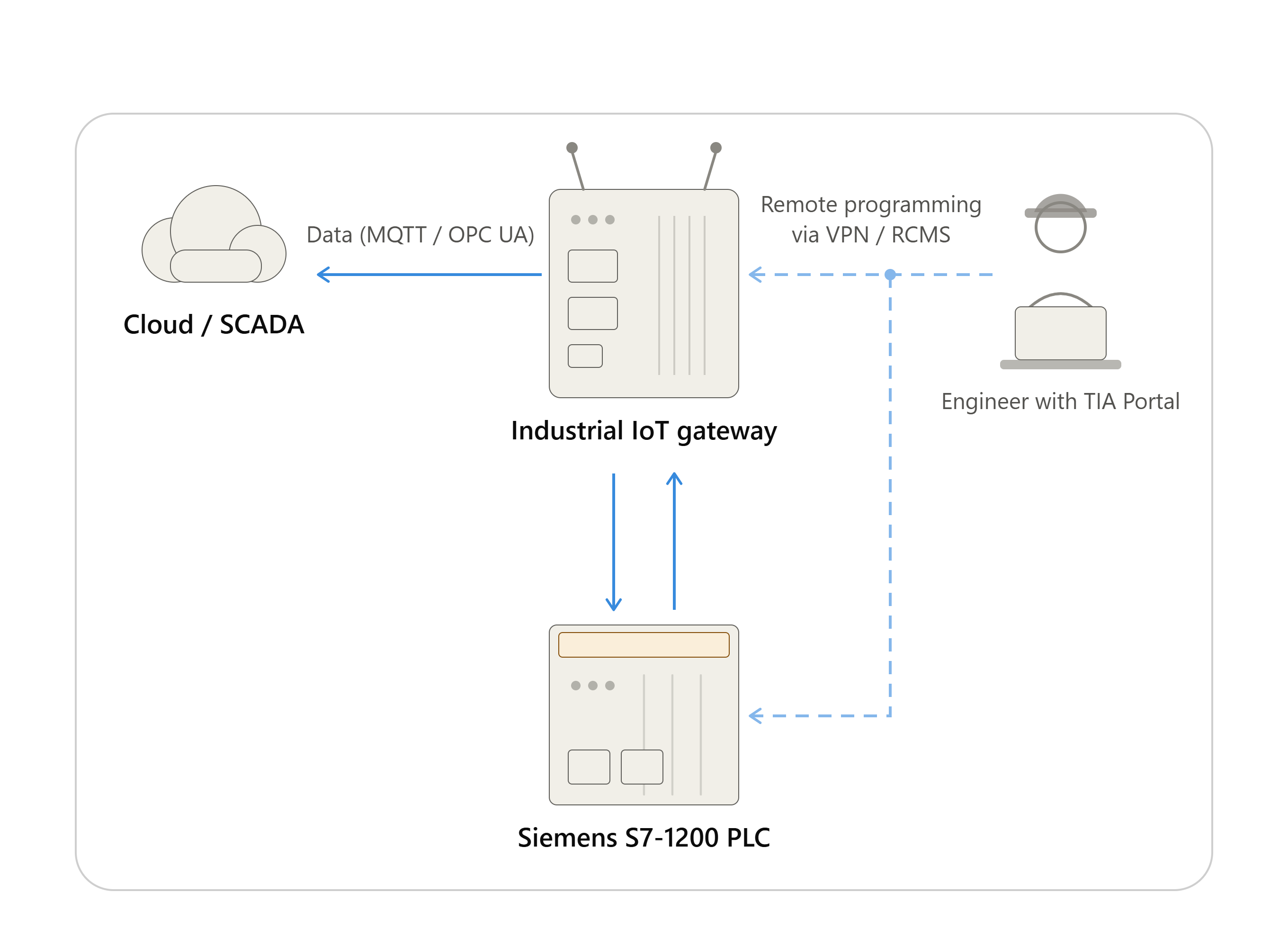
Fig. 2 A Siemens S7-1200 reporting through an industrial IoT gateway, with remote programming access secured over VPN/RCMS rather than opened directly on the PLC.
This guide covers how the current S7 range breaks down, what the S7-1200 and S7-1500 are each actually built for, what legacy S7-300/400 obsolescence means in practice, and the checks worth making before you commit to an order, whether that order is a straightforward replacement or the start of a wider migration. If it is Siemens process instrumentation rather than control hardware you are sourcing, our companion guide to Siemens SITRANS process instrumentation covers that side of the range separately.
Why the S7 family still anchors UK industrial automation
Siemens has been building programmable controllers since the S5 generation, through the S7-200, S7-300 and S7-400 families that defined a huge share of European machine building for two decades, and into the current S7-1200 and S7-1500 generation unified under TIA Portal, Siemens's single engineering environment for programming, HMI and drive configuration in one place.
That continuity is exactly why the platform still dominates UK plant. An integrator trained on S7-300 logic can move to an S7-1500 project without relearning the fundamentals, spares and support are backed by one of the largest automation supply networks in Europe, and TIA Portal gives a single toolchain across the PLC, the HMI panel and the drive rather than three separate programming environments that barely talk to each other.
The current SIMATIC S7 range explained
| Family | Positioning | Typical use |
|---|---|---|
| S7-1200 | Compact, cost-effective | Machine-level control, small skids and standalone OEM machines where a small, self-contained controller is enough. |
| S7-1500 | High-performance, modular | Plant-wide process control, larger machine lines and applications needing extensive distributed I/O or higher processing headroom. |
| S7-1500T / Advanced | Motion-centric | Integrated technology and motion control for applications with synchronised axes, on the same platform as standard process control. |
| S7-1200F / S7-1500F | Failsafe (F-CPU) | SIL and Performance Level-rated safety functions delivered from the same CPU family, rather than a separate safety controller. |
| ET200 (SP / MP) | Distributed I/O | Remote I/O stations extending an S7-1200 or S7-1500 system across a larger physical footprint over PROFINET or PROFIBUS. |
Table 1 The current SIMATIC S7 family by positioning. Check the exact order number (MLFB) against the datasheet, as memory, I/O count and communication options vary considerably within each family.
S7-1200 vs S7-1500: which one actually fits your application
Once the family is right, the practical differences that decide between an S7-1200 and an S7-1500 are about scale and architecture, not just price.
S7-1200
Compact CPU- Integrated I/O on the CPU body itself, minimal separate hardware to mount and wire
- Lower ceiling on I/O count and processing headroom
- Typically one onboard Ethernet port, adequate for a standalone machine
- Most cost-effective choice for a self-contained skid or OEM machine
S7-1500
Rack-based CPU- High-speed backplane with extensive I/O expansion and distributed ET200 stations over PROFINET
- Significantly higher processing headroom for complex or high-speed logic
- Integrated motion and failsafe CPU variants available on the same platform
- Built for larger, plant-wide control architectures rather than a single machine
Legacy S7-300/400: what obsolescence means for your line
Siemens has already withdrawn the S7-300 and S7-400 families from active manufacture, which means any new-build stock you see quoted today is whatever remains in the supply channel rather than fresh production. That does not make an existing S7-300 or S7-400 installation unsafe to keep running; it means the calculation around it has changed.
Sites in this position are generally weighing up two paths. The first is sourcing genuine remaining stock for a like-for-like swap, buying time on a platform the plant and its operators already know well. The second is migrating the control philosophy to the current S7-1200/1500 generation and TIA Portal, which is a larger project but removes the obsolescence risk for the long term rather than deferring it. Neither is automatically the right answer we would rather talk through your specific installation than assume which path fits before we know the machine and the timeline you are working to.
The counterfeit and grey-market PLC problem
A PLC that is small, high in value and produced in huge volume is exactly the kind of part that attracts convincing copies, relabelled stock and units of unclear origin, and Siemens's SIMATIC range is no exception. The consequences of a misrepresented controller are worse than most other parts on site, because it sits at the point where a fault becomes a full line stoppage rather than a degraded reading.
- Counterfeit or altered firmware
- A unit that is not genuine can fail unpredictably rather than cleanly, and may not accept legitimate firmware updates from Siemens at all, leaving you stuck on an unpatched or unstable version.
- No genuine warranty or software activation
- Licensed TIA Portal features and Siemens support both depend on the hardware being genuine. A misrepresented CPU can look identical until an activation or support request exposes the gap.
- Unverified safety certification on F-CPU hardware
- A SIL or Performance Level rating printed on a label is not proof of anything by itself. On a safety-instrumented function, that gap sits inside your safety case, not the seller's.
Verifying a Siemens PLC before you order
- Get the full MLFB (order number) from the nameplate, not just the headline model name, and check it against the Siemens datasheet for that exact variant.
- Ask for the serial number and, where the channel allows it, verify it through Siemens or an authorised distributor rather than taking a seller's word for its origin.
- Treat pricing that undercuts every legitimate supplier by an implausible margin as a warning rather than a bargain, particularly on a discontinued family where genuine stock is naturally scarce.
- Ask who actually held the stock, and for how long. A long, unclear chain of custody is a risk factor on its own, independent of whether the unit is genuine.
- Ask for photographs of the physical unit nameplate, terminal block, firmware version screen rather than a generic catalogue image.
A correct-looking part number on a listing is not proof of anything. Only a verified serial number and a traceable source tell you what the controller actually is. If a seller cannot support that, treat the listing as unverified regardless of how genuine the photos look.
Checks before you order a Siemens PLC
- Confirm the exact MLFB order number, not just "S7-1200" or "S7-1500" the same family name covers dozens of memory, I/O and communication variants.
- Confirm firmware version and TIA Portal compatibility against your existing project, since mismatched versions are a common source of commissioning delays.
- Confirm I/O count and module compatibility against your panel design before ordering, especially when replacing a legacy S7-300/400 CPU with a current-generation equivalent.
- Confirm whether you need a failsafe (F) variant and what certification is expected to accompany it.
- Confirm what software licensing is included TIA Portal Basic, Professional or an upgrade path is often a separate line item from the hardware itself.
- Ask for calibration or certification traceability on any safety-rated hardware as a condition of the order.
- Get the warranty and returns position in writing, including what happens if the unit does not commission correctly on site.
- Confirm a realistic delivery date to site, not a generic dispatch estimate, especially on legacy stock where availability can change quickly.
How British Instruments can help
British Instruments is a trusted UK and US supplier of genuine Siemens SIMATIC hardware, from current S7-1200 and S7-1500 systems through to legacy S7-300 and S7-400 spares for plants still running that generation. Most inquiries we get are not a straightforward in-stock order; they are a maintenance team trying to work out whether a like-for-like swap or a wider migration makes more sense for their specific line, and we would rather have that conversation honestly before anything is quoted.
We supply across the SIMATIC range S7-1200 and S7-1500 CPUs and I/O, ET200 distributed I/O stations, failsafe F-CPU variants, and legacy S7-300/400 spares for plants not yet ready to migrate. Send us the MLFB from the unit you are replacing, or a photograph of the nameplate if you are not sure what you are looking at, and we will confirm the exact variant, verify what is being offered against it, and come back with availability and a realistic delivery date before anything is priced.
If it is process instrumentation feeding into that control system you need pressure, temperature, flow or level our companion guide to Siemens SITRANS process instrumentation covers that side of the Siemens range in the detail this guide deliberately leaves out.
Ready to Source Genuine Siemens Products?
Get competitive pricing, fast delivery in the UK (EU) & US, and dedicated technical support on every order. Reach out now and receive a tailored quote within 24 hours.
Frequently asked questions
MLFB stands for Maschinenlesbare Fabrikatebezeichnung, Siemens's full machine-readable order number. It identifies the exact variant memory size, I/O count, communication interfaces rather than just the family name. Two units both labelled "S7-1500" can have very different specifications, so quoting or ordering against the MLFB rather than the family name avoids mismatches.
Siemens has withdrawn both families from active manufacture, so any stock available now is existing channel inventory rather than new production. Genuine units can still be sourced, but availability narrows over time and verifying authenticity matters more on a discontinued line than on current production. We can help source verified stock while you decide on a migration timeline.
The S7-1200 is a compact controller with integrated I/O, suited to a standalone machine or small skid. The S7-1500 is a rack-based, modular platform with a high-speed backplane, extensive distributed I/O and considerably more processing headroom, built for plant-wide or complex control architectures rather than a single machine.
Only if your machine or process requires a safety instrumented function with a defined SIL or Performance Level rating a guarded access door interlock or an emergency stop chain, for example. A standard CPU cannot be substituted for an F-CPU on a genuine safety function. If you are not sure whether your application needs one, tell us what the function is protecting against and we can help you work it out.
Every current S7-1200 and S7-1500 CPU is programmed through TIA Portal. Legacy S7-300 and S7-400 hardware was originally programmed through the older STEP 7 Classic environment, though later versions of TIA Portal can also handle much of that legacy hardware, depending on the exact CPU and firmware version.
Get the full MLFB and serial number and check them against the Siemens datasheet, ask for verification through Siemens or an authorised distributor where possible, and treat pricing that undercuts the market by an implausible margin as a warning sign rather than a good deal. We verify what we supply before quoting rather than after a purchase order is raised.
Ideally the full MLFB order number from the CPU's nameplate. If you do not have it, a clear photograph of the nameplate and the current firmware version, if visible, is usually enough for us to identify the correct replacement or upgrade path.
Send us the MLFB.
Tell us the controller, the machine it runs and when you need it. We will confirm the exact variant, verify what is being offered, and come back with availability and a realistic delivery date.