
Overview
A panel builder pulls the tag off a failed CPU to order a replacement and finds a catalogue number that no longer appears on Rockwell's own configurator. The chassis is a decade old, the machine is not, and the obvious question sourcing an exact like-for-like replacement or re-platforming the panel onto current hardware turns out to have no single right answer. It depends on the machine, the budget, and how much longer that line needs to keep running unmodified.
That scenario plays out across UK manufacturing on a near-daily basis, because Allen-Bradley, the hardware brand under Rockwell Automation, sits behind an enormous share of the control panels in this country. The current Logix 5000 platform and the smaller Micro800 range cover everything from a single conveyor to a plant-wide process line, and neither is a drop-in substitute for the other; each is built around a genuinely different job.
This guide covers how the current Allen-Bradley PLC range breaks down, where Micro800 stops and Logix starts, what the retirement of the SLC 500 and MicroLogix families means if your panel still runs one, and the checks worth making before an order goes in whether that order is a straightforward spare or the start of a larger migration.
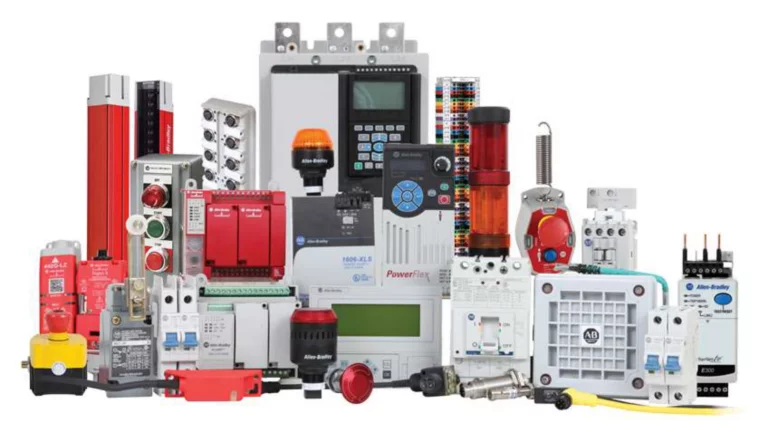
Fig. 1 A cross-section of the Allen-Bradley range covered in this guide PLC modules, drives, safety and sensing hardware.
A Wisconsin motor-control business that became an automation standard
Allen-Bradley was founded in Milwaukee in 1903 as the Compression Rheostat Company, by Dr. Stanton Allen and a 24-year-old engineer named Lynde Bradley. The company's first patented product, a crane controller, was demonstrated at the 1904 St Louis World's Fair, and the business spent the following decades building a reputation in industrial motor control long before the PLC as a category existed.
In 1985, Rockwell International bought Allen-Bradley for $1.651 billion, at the time the largest acquisition in Wisconsin's corporate history. The parent company now trades as Rockwell Automation, but Allen-Bradley has stayed the hardware brand on the nameplate PLCs, drives, sensors and motor control gear all still carry the name that built the reputation in the first place, which is part of why it still reads as a single, trusted identity on a panel door rather than two separate companies.
The current Allen-Bradley PLC range explained
"Allen-Bradley PLC" covers several genuinely different product families, and the right one depends on the scale of the job, not just budget.
| Family | Positioning | Typical use |
|---|---|---|
| Micro800 (Micro820/830/850/870) | Compact, low-cost | Standalone machines and small skids where a full Logix platform is more than the job needs. |
| CompactLogix 5380 / 5480 | Mid-range, modular | Standard machine control and smaller process applications, expandable with distributed I/O over EtherNet/IP. |
| ControlLogix 5580 | High-performance, chassis-based | Large or complex process control, high I/O counts, and applications where redundancy is a requirement rather than an option. |
| GuardLogix (5580 / 5480 safety) | Failsafe | SIL and Performance Level-rated safety functions on the same Logix platform, rather than a separate safety PLC. |
| SLC 500 / MicroLogix / PLC-5 | Legacy, being phased out | Existing installed base only. Rockwell has formally withdrawn support for the SLC 500 platform and is progressively retiring the MicroLogix range alongside it; neither is specified for new projects. |
Table 1 The current Allen-Bradley PLC family by positioning. Always check the exact catalogue number against Rockwell's Product Compatibility and Download Center (PCDC) before ordering memory, I/O and communication options vary considerably within each family.
Micro800 vs Logix 5000: which platform actually fits
Once the family is right, the practical differences between Micro800 and the Logix 5000 platform come down to scale, software and what the machine needs to talk to.
Micro800
Compact controller- Programmed through Connected Components Workbench (CCW), a free, lighter-weight tool separate from Studio 5000
- Lower ceiling on I/O count, memory and communication options
- No native EtherNet/IP scanner on every variant expansion depends on the specific model
- Most cost-effective choice for a self-contained OEM machine or simple skid
Logix 5000 (CompactLogix / ControlLogix)
Modular platform- Programmed through Studio 5000 Logix Designer, the same environment across the whole Logix family
- Full EtherNet/IP networking built on the CIP protocol, with extensive distributed I/O
- GuardLogix failsafe variants available on the same platform for safety-rated functions
- Built for plant-wide architectures, redundancy and higher processing headroom, not a single small machine
SLC 500 and MicroLogix: what retirement means for your panel
Rockwell formally ended support for the SLC 500 platform in 2023, and has been steadily retiring the MicroLogix range that sat alongside it as the smaller, standalone option for decades. That does not make an existing SLC 500 or MicroLogix panel unsafe to keep running it means the calculation around it has changed, and new-build stock now comes from whatever remains in the supply channel rather than fresh production.
Sites in this position are usually weighing the same two paths we see with any retired PLC family. The first is sourcing genuine remaining stock for a like-for-like swap, buying time on a platform the plant and its operators already know. The second is migrating the control logic to CompactLogix or ControlLogix and Studio 5000, a bigger project up front but one that removes the obsolescence risk for good rather than deferring it. Which one makes sense depends on the machine and the timeline, not on a general rule, so we would rather talk it through than assume.
The counterfeit and grey-market PLC problem
A controller that is compact, high in value and deployed in enormous volume is exactly the kind of part that attracts convincing copies, relabelled modules and stock of unclear origin, and Allen-Bradley's Logix range is no exception. Rockwell Automation has publicly warned customers about counterfeit product entering the supply chain, and the consequences of an unverified PLC are worse than most other parts on site, because it sits at the exact point where a fault becomes a full line stoppage rather than a degraded reading.
- Counterfeit or altered firmware
- A unit that is not genuine can fail unpredictably rather than cleanly, and may not accept legitimate firmware updates from Rockwell at all, leaving you stuck on an unpatched or unstable version.
- No genuine warranty or software activation
- Studio 5000 licensing and Rockwell's own support both depend on the hardware being genuine. A misrepresented CPU can look identical until an activation or support request exposes the gap.
- Unverified safety certification on GuardLogix hardware
- A SIL or Performance Level rating printed on a label is not proof of anything by itself. On a safety-instrumented function, that gap sits inside your safety case, not the seller's.
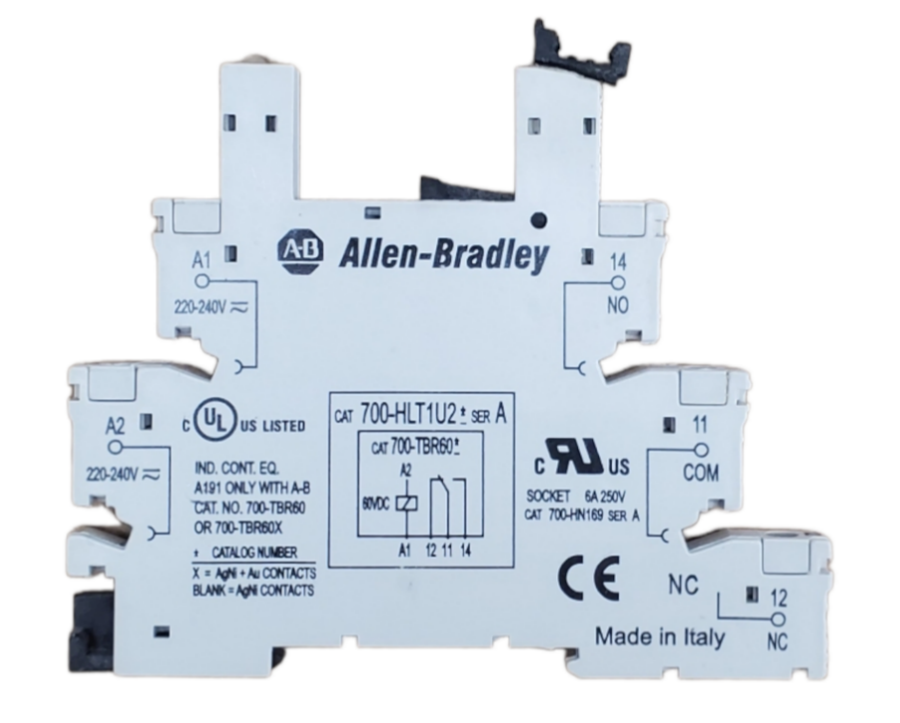
Fig. 2 The catalogue number, certification marks and wiring diagram printed on a genuine Allen-Bradley nameplate exactly the detail worth checking before you order.
Verifying an Allen-Bradley PLC before you order
- Get the full catalogue number from the nameplate, not just the family name, and check it against Rockwell's Product Compatibility and Download Center (PCDC) for that exact variant.
- Ask for the serial number and, where the channel allows it, verify it through Rockwell or an authorised distributor rather than taking a seller's word for its origin.
- Treat pricing that undercuts every legitimate supplier by an implausible margin as a warning rather than a bargain, particularly on a retired family where genuine stock is naturally scarce.
- Ask who actually held the stock, and for how long. A long, unclear chain of custody is a risk factor on its own, independent of whether the unit is genuine.
- Ask for photographs of the physical unit nameplate, terminal block, firmware revision screen rather than a generic catalogue image.
A correct-looking catalogue number on a listing is not proof of anything. Only a verified serial number and a traceable source tell you what the controller actually is. If a seller cannot support that, treat the listing as unverified regardless of how genuine the photos look.
Checks before you order an Allen-Bradley PLC
- Confirm the exact catalogue number, not just "CompactLogix" or "ControlLogix" the same family name covers dozens of memory, I/O and communication variants.
- Confirm firmware revision and Studio 5000 (or CCW) compatibility against your existing project, since mismatched versions are a common source of commissioning delays.
- Confirm chassis, power supply and module compatibility before ordering, especially when replacing a legacy SLC 500 or MicroLogix CPU with a current-generation equivalent.
- Confirm whether you need a GuardLogix variant and what certification is expected to accompany it.
- Confirm what software licensing is included Studio 5000, FactoryTalk components or an upgrade path are often separate line items from the hardware itself.
- Ask for calibration or certification traceability on any safety-rated hardware as a condition of the order.
- Get the warranty and returns position in writing, including what happens if the unit does not commission correctly on site.
- Confirm a realistic delivery date to site, not a generic dispatch estimate, especially on legacy stock where availability can change quickly.
How British Instruments can help
British Instruments is a trusted UK and US supplier of genuine Allen-Bradley hardware, from current CompactLogix and ControlLogix systems through to SLC 500 and MicroLogix spares for panels still running that generation. Most inquiries we get are not a straightforward in-stock order; they are a panel builder or maintenance team working out whether a like-for-like swap or a wider migration makes more sense for their specific machine, and we would rather have that conversation honestly before anything is quoted.

We supply across the Allen-Bradley range Micro800, CompactLogix and ControlLogix controllers and I/O, GuardLogix safety variants, and legacy SLC 500/MicroLogix spares for panels not yet ready to migrate. Send us the catalogue number from the unit you are replacing, or a photograph of the nameplate if you are not sure what you are looking at, and we will confirm the exact variant, verify what is being offered against it, and come back with availability and a realistic delivery date before anything is priced.
Ready to Source Genuine Allen-Bradley Products?
Get competitive pricing, fast delivery in the UK (EU) & US, and dedicated technical support on every order. Reach out now and receive a tailored quote within 24 hours.
Frequently asked questions
Rockwell Automation is the parent company; Allen-Bradley is the hardware brand name that appears on the nameplate PLCs, drives, sensors and motor control gear. Rockwell International acquired the original Allen-Bradley company, founded in Milwaukee in 1903, in 1985, but kept the name on the products because of the reputation already built into it.
Rockwell formally ended support for the SLC 500 platform in 2023 and has been progressively retiring the MicroLogix range alongside it, so any stock available now is existing channel inventory rather than new production. Genuine units can still be sourced, but availability narrows over time and verifying authenticity matters more on a retired line than on current production. We can help source verified stock while you decide on a migration timeline.
Micro800 is a compact controller programmed through Connected Components Workbench, suited to a standalone machine or small skid where a full Logix platform is more than the job needs. CompactLogix runs on the Logix 5000 platform through Studio 5000 Logix Designer, with full EtherNet/IP networking and considerably more headroom for distributed I/O and larger control architectures.
Only if your machine or process requires a safety instrumented function with a defined SIL or Performance Level rating a guarded access door interlock or an emergency stop chain, for example. A standard Logix controller cannot be substituted for a GuardLogix on a genuine safety function. If you are not sure whether your application needs one, tell us what the function is protecting against and we can help you work it out.
Every current CompactLogix and ControlLogix CPU is programmed through Studio 5000 Logix Designer. Micro800 controllers use the separate, lighter-weight Connected Components Workbench instead. Legacy SLC 500 and MicroLogix hardware was originally programmed through RSLogix 500, a different environment again.
Get the full catalogue number and serial number and check them against Rockwell's Product Compatibility and Download Center, ask for verification through Rockwell or an authorised distributor where possible, and treat pricing that undercuts the market by an implausible margin as a warning sign rather than a good deal. We verify what we supply before quoting rather than after a purchase order is raised.
Ideally the full catalogue number from the CPU's nameplate. If you do not have it, a clear photograph of the nameplate and the current firmware revision, if visible, is usually enough for us to identify the correct replacement or upgrade path.
Send us the catalogue number.
Tell us the controller, the machine it runs and when you need it. We will confirm the exact variant, verify what is being offered, and come back with availability and a realistic delivery date.