
Overview
Someone is holding a torn nameplate, or worse, a purchase requisition with a long string like 3051CD3A22A1AB4M5 typed into it, trying to work out whether the "equivalent" a supplier has offered is actually the same transmitter that just failed. It is not an unusual position to be in. The 3051's option string carries model, sensor type, range, material and connection all in one line, and it is easy to match six characters out of nine and still order the wrong part.
The Rosemount 3051 is the transmitter most UK sites reach for by default, and for good reason. It has been in continuous production for over two decades, it covers differential, gauge and absolute pressure from the same basic sensor, and spares availability is generally good compared with older or more specialised instruments. That familiarity is also why it gets ordered carelessly the option string looks like it should be readable at a glance, and mostly it is, right up until the field that actually matters gets skipped.
This guide covers the 3051 specifically its Coplanar platform, its variant family, accuracy, wetted materials, protocol options and the part-number fields worth checking before you commit to an order. If you are still deciding between Rosemount families entirely differential versus in-line, or whether you need a 3051 at all rather than a 2051 or 3051S our wider guide to the Rosemount pressure transmitter range covers that ground at survey level. This one goes deep on the 3051 alone.
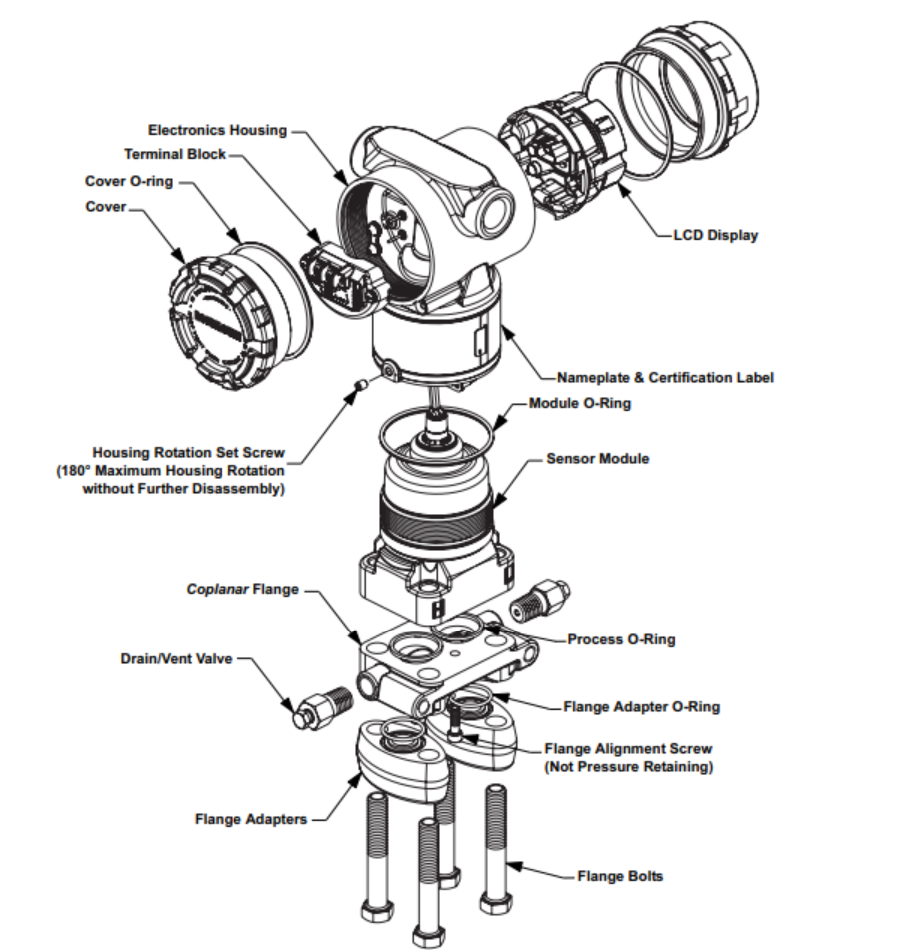
Fig. 2 The core components of a Rosemount Coplanar transmitter, exploded. The sensor module sits between the electronics housing and the Coplanar flange that bolts to the process.
The Coplanar platform: one sensor, three measurements
"Coplanar" refers to the flange design Rosemount introduced with the original 3051 the process connections sit in the same plane on a single flange casting, rather than as separate ports threaded into opposite sides of the sensor body. That sounds like a mechanical detail, and mostly it is, but it is the detail that makes the rest of the platform work.
Underneath the flange sits one sensor module. What determines whether the finished transmitter reads differential, gauge or absolute pressure is not a different sensor it is the isolator and flange arrangement built onto that sensor at manufacture. A differential configuration presents two process taps to two sides of the same capacitance cell. A gauge configuration presents one tap referenced to atmosphere through a vent. An absolute configuration presents one tap referenced to a sealed vacuum reference built into the cell. Same electronics housing, same core sensing technology, three different jobs depending on how the body around it was built.
The 3051 is not three transmitters that happen to share a part-number prefix. It is one sensor platform, wearing three different flanges.
Practically, that matters in two ways. First, for anyone holding spares, it means the range of distinct sensor modules you need to stock is smaller than the number of finished transmitter variants suggests most of the variation lives in the flange, isolator, manifold and materials rather than in the measuring element itself. Second, it is part of why the 3051 behaves consistently across the range accuracy, response time and long-term stability come from one well-proven cell design, not from three separately developed ones.
Where this catches people out is the assumption that a transmitter can be moved between duties in the field by changing a setting. It cannot in any meaningful sense. Whether a unit is DP, gauge or absolute is fixed by the physical isolator and flange fitted at manufacture, and that is set well before the transmitter leaves the factory. More on that in the FAQ below.
The 3051 family, model by model
"3051" on its own is a platform name, not a single product. The letter that follows the model prefix identifies which member of the family you are actually looking at, and each does a genuinely different job.
| Model | Configuration | Typical use |
|---|---|---|
| 3051C | Coplanar DP, gauge or absolute | The core workhorse. Covers the great majority of general process pressure and differential duty across the plant. |
| 3051S | SuperModule platform | Enhanced diagnostics and stability, with an optional multivariable output combining pressure and process temperature for compensated mass flow, and optional WirelessHART. |
| 3051T | In-line gauge or absolute | Threaded or flanged in-line body for high static line pressure duty, or hygienic/sanitary process connections where a coplanar flange is not appropriate. |
| 3051L | Hydrostatic level | Tank level measured as a differential pressure against a fixed reference, typically a flanged or extended-diaphragm arrangement fitted low on the vessel. |
| 3051CD (flow) | DP across a primary element | Differential pressure across an orifice plate or an averaging pitot (Annubar-type) element, used to infer flow rate. |
Table 1: The 3051 family by model letter. Each still relies on the same underlying Coplanar or in-line sensor approach.
Accuracy, turndown and stability
Reference accuracy on a standard 3051C is commonly quoted at around 0.065% of calibrated span. Higher specification configurations SuperModule and Ultra variants in particular are offered with tighter figures, down to roughly 0.025% of span on the best options. Those two numbers are worth knowing as a rough map of where the range sits, not as a guarantee for any specific unit.
Turndown (or rangeability) is one of the more useful practical features of the platform. A single range code covers a fairly wide span of possible calibrated ranges, so the same physical sensor can be field-configured or ordered pre-set for a low-span application or a much higher one within that code, without needing a different range code altogether. That flexibility is genuinely useful when a process span changes slightly during a plant modification, or when spares holding needs to cover more than one duty with fewer distinct part numbers.
Long-term stability is quoted as a drift figure over a period of years, and it is what determines how often a transmitter genuinely needs recalibrating rather than simply being assumed to have drifted. Always confirm the exact figure for your specific model and range code against the current datasheet or the unit's own nameplate accuracy classes vary between standard and enhanced/Ultra options, and quoting the wrong one against a stated process requirement is an easy way to fail a specification review after the fact.
Wetted parts and diaphragm materials
The isolating diaphragm and other wetted parts on a standard 3051 are 316L stainless steel. For most clean or moderately aggressive process fluids that is entirely adequate, and it is the material most spares holdings are built around.
Where the process medium is not compatible with 316L chlorides, certain acids, some hydrocarbon streams with trace contaminants Rosemount offers Hastelloy C, Monel or tantalum diaphragm options. Each exists because 316L attacks or degrades in a specific class of service, and the option list is not decorative.
Getting this wrong does not usually produce a dramatic failure. Diaphragm attack from an incompatible process fluid is typically slow corrosion, pitting, gradual loss of calibration through mechanical creep and it can run for months before anyone notices the reading has quietly stopped meaning what it used to. By the time it fails outright, you have usually lost the plant history that would have told you when the drift started. If a process stream is even mildly aggressive, it is worth confirming material compatibility against the actual fluid before ordering, not assuming 316L will be fine because it usually is elsewhere on the plant.
Reading a 3051 part number
This is where ordering errors happen most often. A 3051 option string reads like one long code, but it is really several independent fields stacked next to each other, and getting one field wrong can produce a transmitter that looks right at a glance and is not.
- Model. 3051C identifies the Coplanar platform. Other prefixes in the family 3051S, 3051T, 3051L are different physical bodies and are not interchangeable with a 3051C simply because the leading digits match.
- Sensor/output type. Identifies whether the unit is built as differential, gauge or absolute, and the output signal it carries. This field is set at manufacture and is the single most important thing to check against a failed unit before ordering a replacement.
- Range. Identifies the calibrated span code fitted to the sensor. Because of turndown, one range code can cover more than one actual working span check the code covers your process span with reasonable margin, not just that it happens to be the same code as before.
- Wetted material. Identifies the isolating diaphragm and wetted parts material 316L stainless as standard, with Hastelloy C, Monel or tantalum as options for incompatible process media.
- Process connection. Identifies the flange type, bolting and rating that mate the transmitter to your process piping or manifold. Getting this field wrong is a mechanical fit problem, not just a paperwork one.
- Options. A trailing set of codes covering items such as display/indicator, hazardous area approvals, alarm configuration and mounting brackets. Multiple option codes can be stacked, and it is easy to miss one buried at the end of a long string.
Fig. 3 Illustrative breakdown of a Rosemount 3051 option string. This is a representative guide to the fields involved it is not a substitute for Emerson's own model number configurator, and exact code letters vary by revision and sub-family. Always confirm the precise codes against the current datasheet or the transmitter's own nameplate before ordering.
If you have a failed unit in hand and the nameplate is damaged or only partly legible, the safest route is to photograph what remains legible and send it over. We would rather work through it with you than have a guess become the order that gets built.
Output signal and protocol options
4-20mA with HART is the default and by far the most common choice it works with essentially any HART-capable host system, configuration tool or handheld communicator already on site, and it is the safest option when you are not entirely sure what the receiving system expects.
FOUNDATION Fieldbus and Profibus PA are digital, multi-drop protocols aimed at plants where the DCS integration is built around one of those buses rather than point-to-point 4-20mA. If the rest of the area is already wired for Fieldbus or Profibus PA, matching the new transmitter to that bus avoids adding an odd one out that needs its own interface card.
WirelessHART is available through the 3051S SuperModule option, aimed specifically at measurement points where running new cable is impractical or disproportionately expensive relative to the value of the measurement, rather than as a general replacement for wired instruments.
Installation practice that actually affects the reading
A correctly specified transmitter fitted badly will still give you a wrong number, and most of the calls that start "the transmitter must be faulty" turn out to be an installation issue rather than an instrument one.
Impulse line routing matters more than it gets credit for. On liquid service, lines should slope continuously so any entrained gas can migrate back to the process rather than sitting in a high point of the line as a pocket. On steam or vapour service, the concern runs the other way condensate needs to drain back rather than collecting in a low point and effectively becoming part of the measurement. Either way, a bubble or a slug sitting somewhere it should not be will bias the reading by an amount that has nothing to do with the transmitter's own accuracy, and it will do it consistently, which makes it look like a genuine process change rather than an installation fault.
Venting and draining before commissioning is not optional housekeeping it is part of getting a correct zero. Trapped air in a liquid-filled line, or trapped liquid in a gas or steam line, shows up later as a slow drift or a reading that never quite settles, and by then it is much harder to diagnose than it would have been at commissioning.
Mounting position relative to the process tap matters for the same reason. Mounting above the tap on liquid service, or below it on steam service, is the usual guidance specifically so the impulse line fills or drains the way it is meant to rather than fighting gravity.
The failure mode worth knowing about is the one that does not announce itself. A manifold valve left a quarter-turn off fully open, or an impulse line that has partially blocked with process debris, does not usually stop the transmitter producing a reading. It produces a reading that is entirely plausible, sits within a sensible-looking range, and is simply wrong quietly biased, or slow to respond to a genuine process change. That is the kind of fault that survives a casual walk-past inspection and gets found only when someone cross-checks against an independent reading or a mass balance.
Checks before you order a 3051
- Confirm the exact model and option string against the unit being replaced, field by field, rather than matching on the leading digits alone.
- Confirm the range code covers your actual process span with reasonable turndown margin, not just that it matches the failed unit's code.
- Confirm the wetted material suits your process media. Do not assume 316L is fine simply because it is standard elsewhere on the plant.
- Confirm the process connection and flange rating matches your existing piping or manifold before it arrives on site.
- Confirm the output protocol matches your host system 4-20mA HART, Fieldbus, Profibus PA or WirelessHART.
- State the hazardous area zone and approval requirement up front, so the correct approval option is built in rather than discovered missing on delivery.
- Specify a local display or indicator if the installation needs one it is an option, not a default on every unit.
- Ask for a calibration certificate and traceability with the unit, particularly where the measurement feeds a custody transfer, safety or audited process.
- Confirm realistic delivery to site and warranty in writing before the order is placed, not after.
How British Instruments can help
British Instruments is a trusted UK and US supplier of genuine Rosemount pressure transmitters. When a 3051 fails, the useful thing is not a lecture on the Coplanar platform it is confirmation of the exact model and option string you actually need, at a fair price, on site in time to matter.

We supply Rosemount 3051 transmitters across the range 3051C, 3051S, 3051T, 3051L and 3051CD flow configurations along with the manifolds, mounting brackets and calibration paperwork that go with them. Send us the option string from the unit you are replacing, or a photograph of the nameplate, and we will confirm the correct build before anything is priced.
If you are still working out which Rosemount family suits a new application, our wider guide to the Rosemount pressure transmitter range covers the survey-level comparison across the full pressure line. If you are sourcing temperature instrumentation for the same project, our guide to Rosemount temperature transmitters covers that side separately.
Ready to Source Genuine Rosemount Products?
Get competitive pricing, fast delivery in the UK (EU) & US, and dedicated technical support on every order. Reach out now and receive a tailored quote within 24 hours.
Frequently asked questions
The 3051C is the standard Coplanar transmitter covering DP, gauge and absolute duty. The 3051S is the SuperModule platform built on the same underlying sensing approach, but with enhanced diagnostics, tighter accuracy options, and the ability to add a second sensor for multivariable output (pressure plus process temperature) used for compensated mass flow, along with optional WirelessHART.
Generally no. Which measurement type a 3051 provides is fixed by the isolator and flange arrangement fitted at manufacture, not by a field setting. Always check the physical unit and its datasheet rather than assuming a transmitter can simply be reconfigured on site.
A standard 3051C is commonly quoted around 0.065% of calibrated span, with enhanced SuperModule and Ultra configurations available down to roughly 0.025%. Always confirm the exact figure for your specific model and range code against the current datasheet or the unit's own nameplate, since accuracy classes vary between standard and enhanced options.
The standard isolating diaphragm and wetted material is 316L stainless steel. Where the process fluid is not compatible with 316L, Hastelloy C, Monel or tantalum options are available. Confirm compatibility against your actual process fluid rather than assuming 316L will be adequate because it usually is elsewhere on the plant.
Yes, through the 3051S SuperModule option. It is aimed at measurement points where running new cable is impractical or disproportionately costly, rather than as a general substitute for wired instruments.
The usual culprits are a manifold valve left slightly open, a partially blocked impulse line, or gas or condensate trapped in an impulse line that should have been sloped or vented properly. None of these stop the transmitter producing a reading they just make it wrong in a way that looks entirely reasonable until it is checked against an independent measurement.
Approvals are specified as options within the part number and vary by region and certification scheme. Tell us the zone, gas group and certification standard you need ATEX, IECEx or otherwise and we will confirm the correct build rather than assume one covers all cases.
Ideally the full option string from the nameplate of the unit being replaced, along with your process span, media and any hazardous area requirement. If the nameplate is damaged, a photograph of what remains legible is usually enough for us to work out the rest.
Send us your option string.
Tell us the model, the process it measures and when you need it on site. We will confirm the exact build sensor type, range, materials and connection and come back with availability and a realistic delivery date.