
Overview
A tank reading creeps up by two or three degrees during a shutdown, and nobody can say with any confidence whether that is the process actually warming, a drifting RTD, or a transmitter that has started lying. Someone eventually pulls up the second sensor reading on the same point, compares it against the first, and only then does the picture become clear. That comparison is only possible because the transmitter was specified with a second sensor input in the first place.
Rosemount's temperature transmitter range covers a lot of ground, from a simple single-sensor head-mount unit through to a multi-channel rail-mount transmitter monitoring a whole skid. The right choice depends on how many sensors the point actually needs, what protocol your host system speaks, and how much the consequence of a missed or wrong reading actually matters on that particular loop.
This guide covers the sensor types and wiring behind them, the standout dual-sensor Hot Backup feature on the 3144P, the output protocol options, where accuracy actually comes from, and the checks worth making before you place an order. If you are also sourcing pressure instrumentation for the same project, our guide to Rosemount pressure transmitters covers that range separately pressure is not the subject of this guide.
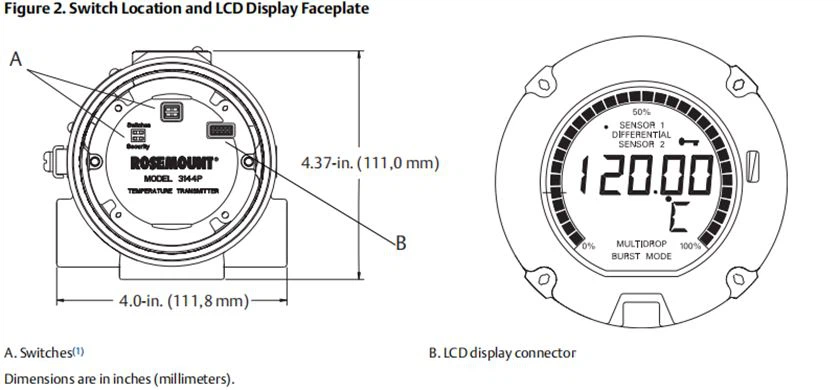
Fig. 2 The 3144P's switch location and LCD faceplate. On a dual-sensor unit the display can show both sensor readings and the differential between them at a glance.
Why measure through a transmitter at all
An RTD or thermocouple on its own does not produce a signal a control system can use directly. A Pt100's resistance change is small and needs converting to a linear temperature value. A thermocouple's output is a few tens of microvolts per degree, it is inherently non-linear across its range, and it needs a cold junction reference to mean anything at all. Neither is something you want to send fifty or a hundred metres of cable run back to a marshalling cabinet and trust.
Run either signal any distance and it picks up noise, and in the RTD's case, lead resistance starts adding itself to the measurement before the signal has gone anywhere useful. A head-mounted transmitter sits right at the sensor, does the linearisation and cold-junction compensation there, and sends a robust signal typically 4-20mA or a digital protocol back to the control system instead of a fragile millivolt or milliohm signal.
That is the whole case for a transmitter before any model numbers come into it: it turns a delicate sensor output into a measurement that survives the trip back to the control room.
The Rosemount temperature transmitter range
Three formats cover most applications we see quoted in the UK. Which one fits depends on how many sensor points you are covering from a given location and how much redundancy and diagnostic capability the loop actually justifies.
| Model | Format | Typical use |
|---|---|---|
| 648 | Economy head-mount Single sensor |
Straightforward single RTD or thermocouple applications where dual-sensor input and advanced diagnostics are not required. The cost-effective option for a large population of ordinary measurement points. |
| 3144P | Head-mount Dual sensor |
The advanced workhorse of the range. Dual-sensor input capability, HART and FOUNDATION Fieldbus options, and diagnostics including Hot Backup and sensor drift alert. Specified wherever the point matters enough to justify it. |
| 848T | Rail/DIN-mount Multi-channel |
Monitors several temperature points from a single enclosure, for example a tank farm or a multi-point skid where running individual head-mount transmitters to every point is impractical. |
Table 1 Rosemount temperature transmitter formats by typical application.
RTD and thermocouple inputs, and why wiring matters
The sensor decision comes first, and it splits into two broad families. RTDs most commonly a Pt100 are the usual choice for stable process temperatures where good accuracy and repeatability matter, because their resistance-versus-temperature relationship is well behaved and reasonably linear. Thermocouples type J, K, T, N, E, R, S and B cover much wider temperature ranges and tend to get specified where a bare-wire or physically rugged sensor suits the installation better, or where the process temperature is simply beyond what an RTD sheath can survive.
Once you have settled on an RTD, the wiring configuration decides how much of the cable run's own resistance ends up baked into your reading. As the diagram above shows, there are three arrangements in common use:
- 2-wire. The simplest connection, and the one to be wary of. Lead resistance sits in series with the sensor element and adds directly to the measured value, with no way for the transmitter to tell the difference between "sensor got warmer" and "cable got longer." Acceptable only over very short runs, where the lead resistance is small enough to ignore.
- 3-wire. The common industrial compromise, and what you will find on the large majority of process RTD installations. A third lead lets the transmitter measure and subtract the lead resistance, on the assumption that both current-carrying leads are equal in length and resistance, which in a properly installed twisted pair they generally are.
- 4-wire. The most accurate arrangement. Separate current-supply and voltage-sense leads mean the lead resistance in the sense path carries effectively no current, so it drops out of the measurement almost entirely. Used where the accuracy of the reading genuinely matters and the extra cable core is not a problem.
If you are replacing a transmitter on an existing installation, match the wiring configuration to what is already run to site. Turning up with a 4-wire transmitter to feed a 3-wire cable run does not gain you anything you cannot use, and turning up with a 2-wire unit on a run that needs compensation will quietly degrade the reading.
Dual-sensor redundancy and Hot Backup
The 3144P's standout feature is what it does with a second sensor input. Fit two RTDs or two thermocouples to the same process point and the transmitter can run both simultaneously, comparing them against each other as a live diagnostic rather than simply carrying a spare in reserve.
If the primary sensor fails or its reading drifts out of a sensible range, Hot Backup switches the transmitter's output to the second sensor automatically, without the kind of interruption that would trip a control loop or force a shutdown. The measurement continues from the surviving sensor while the failed one is dealt with at a convenient time rather than an emergency one.
Just as usefully, comparing the two sensor readings against each other lets the transmitter flag developing sensor drift long before either reading looks obviously wrong on its own. That is the difference between catching a sensor going bad on a routine check and finding out about it because a batch went outside specification.
Operationally, this is what justifies the extra cost of a dual-sensor transmitter on the points where it is fitted: it turns a single-sensor failure from an unplanned intervention often meaning access to a vessel or a shutdown of some kind into a scheduled one.
Output signal and protocol options
Rosemount temperature transmitters are available across the output options you would expect from the range, and the right one is dictated by what your host system actually speaks rather than by which is "best":
- 4-20mA with HART. By far the most common choice. The transmitter behaves as a conventional 4-20mA loop for the primary measurement, with HART digital communication superimposed on top for configuration, diagnostics and secondary variables. Works with any HART-capable host or handheld communicator, which makes it the safe default when you are not sure what else might need to talk to the transmitter over its life.
- FOUNDATION Fieldbus. A fully digital, multi-drop protocol for sites running an FF-based DCS. Multiple transmitters share a single pair of wires back to the control system, and function blocks can run in the field device itself rather than only in the controller.
- Profibus PA. Worth knowing it exists elsewhere in the wider Rosemount portfolio, for sites standardised on a Profibus PA fieldbus rather than FOUNDATION Fieldbus, even though it is less commonly specified on the temperature range specifically.
Match the protocol to your existing host system and engineering tools first. A transmitter is not the place to introduce a new protocol to a plant that has never supported it.
Accuracy and where it actually comes from
Loop accuracy is not a single number that lives on the transmitter's datasheet. It is a combination of the sensor's own accuracy class RTDs have defined tolerance classes governing how closely a given element matches the standard resistance-temperature curve and the transmitter's own conversion and reference accuracy on top of that.
A transmitter with excellent reference accuracy paired with a poor-quality or badly installed sensor still hands you a poor-quality measurement. The transmitter cannot correct for a sensor that was never that accurate to begin with, or one installed with a poor thermowell fit, insufficient immersion length, or a damaged element.
Transmitter reference accuracy is typically quoted as a fraction of a degree on the current datasheets, but treat any number you have seen quoted casually with caution always check the current datasheet figure for the exact sensor-and-transmitter combination you are specifying, since accuracy figures vary by sensor type, temperature range and transmitter model.
Checks before you order
Whoever you buy from, including us, these are worth running through before the purchase order goes in.
- Confirm sensor type and wiring configuration. RTD or thermocouple, and for RTDs whether it is 2, 3 or 4-wire matches the existing installation on site.
- Confirm whether dual-sensor or Hot Backup is needed for this particular point, based on how much an unplanned intervention on it would actually cost you.
- Confirm the output protocol matches your host system 4-20mA HART, FOUNDATION Fieldbus, or otherwise before anything is priced.
- Confirm housing and head type, and thread entry, match your existing wiring and conduit or gland arrangement.
- State the hazardous area zone and approval requirement up front, so the correct certified variant is quoted the first time.
- Confirm calibration certificate and traceability requirements, particularly where the measurement feeds a custody transfer or quality record.
- Ask about sensor drift alert and diagnostic configuration if the point is dual-sensor, so the feature is actually set up rather than left at default.
- Check the sensor's accuracy class and range genuinely suit the process, not just the transmitter's own headline specification.
- Get warranty and a realistic delivery date to site in writing before you commit.
How British Instruments can help
British Instruments is a trusted UK and US supplier of genuine Rosemount temperature transmitters across the 648, 3144P and 848T ranges. Getting the sensor type, wiring configuration and protocol right before an order is placed saves everyone a returned unit and a delayed installation, so that is where we put the effort.

We supply Rosemount temperature transmitters across sensor type, wiring configuration, output protocol and hazardous area approval, along with the RTDs and thermocouples to go with them. If you are also sourcing pressure instrumentation for the same project, our guide to the Rosemount pressure transmitter range covers that side separately, and our deep dive into the Rosemount 3051 goes further into that specific pressure transmitter if it is on your list too.
Send us the sensor type, wiring configuration, protocol and any hazardous area requirement for the point you are specifying, and we will confirm the right transmitter and come back with availability, calibration paperwork and a realistic delivery date before anything is priced.
Ready to Source Genuine Rosemount Products?
Get competitive pricing, fast delivery in the UK (EU) & US, and dedicated technical support on every order. Reach out now and receive a tailored quote within 24 hours.
Frequently asked questions
The 648 is an economy head-mount transmitter for a single sensor, suited to straightforward applications. The 3144P is the more advanced unit, accepting two sensor inputs, supporting HART and FOUNDATION Fieldbus, and adding diagnostics such as Hot Backup and sensor drift alert. The 3144P costs more, and it is specified where the point justifies that extra capability.
Yes, it needs two sensors fitted to the same process point. Hot Backup lets the 3144P switch its output automatically to the second sensor if the primary one fails or drifts outside a sensible range, without the interruption a single-sensor failure would otherwise cause. It also compares the two readings against each other to flag developing drift before it becomes an outright failure.
As a general guide, an RTD such as a Pt100 suits stable process temperatures where accuracy and repeatability matter most. A thermocouple suits wider temperature ranges, or installations where a bare-wire or more rugged sensor construction is the better physical fit. Where the specific temperature range and mechanical environment sit outside typical bounds, it is worth talking the application through before deciding.
3-wire wiring compensates for lead resistance on the assumption that both current-carrying leads are equal, which covers most industrial installations well. 4-wire wiring separates the current and sense paths so lead resistance drops out of the measurement almost entirely, giving the highest accuracy at the cost of an extra cable core. Use 4-wire where the accuracy of the reading genuinely matters.
Yes. The 3144P is available with a FOUNDATION Fieldbus output alongside the more common 4-20mA HART option, for sites running an FF-based DCS. Confirm which output you need before ordering, since it is a build option rather than something that can be changed afterwards.
Rosemount temperature transmitters are available with a range of hazardous area certifications covering different zones and protection concepts. Tell us the zone, gas group and certification scheme required for your site and we will confirm the correct variant before quoting.
Ideally the sensor type and wiring configuration, whether dual-sensor input is needed, the output protocol your host system uses, and any hazardous area requirement. If you have a part number from an existing transmitter, send that too and we will confirm the equivalent before pricing anything.
Send us your application.
Tell us the sensor type, wiring configuration, protocol and any hazardous area requirement. We will confirm the right transmitter and come back with availability, calibration paperwork and a realistic delivery date.